2023年5月21日 星期日

week 14. thought experiments

1. Students share final project proposal

2. Thought experiments (Speculative Everything  一書的文字)

"One way this might be possible is to treat design speculations not as
narratives or coherent “worlds” but as thought experiments—constructions,
crafted from ideas expressed through design—that help us think about
difficult issues." p. 80. SE
"一個可行之道是不要把設計推測當成敘事或條理分明的「世界」看待,而要視為能幫助我們思考困難議題的思想實驗――用經由設計表達的構思,精心建造的物品。 " P. 105

"Thought experiments are usually done in fields
where it is possible to precisely define limits and rules, such as mathematics,
science (particularly physics), and philosophy (especially ethics) to test
ideas, refute theories, challenge limits, or explore possible implications.
They make full use of the imagination and are often beautiful designs in
themselves."

"思想實驗通常是在有可能劃定界線和規則的領域進行,例如數學、科學(特別是物理學)和哲學(尤其是倫理學),來測試構思、駁斥理論、質疑限制或探究可能的後果。¹ 它們充分運用想像力,本身也常是美麗的設計。"

"One of our favorite forms of thought experiment uses reductio ad absurdum,
a type of logical argument in which one assumes a claim for the sake of
argument and derives an absurd or ridiculous outcome by taking it to its
extreme, concluding that the original claim must have been wrong because it
led to such an absurd result."

"我們最鍾意的一種思想實驗是採用歸謬法(reductio ad absurdum),在這種邏輯論證中,我們為便於討論,假設了某個主張,並將之推演到極致而導出荒謬的結果,進而斷定,既然原來的主張會產生如此荒謬的結果,它必是謬誤。" P. 107

"Another well-established form of thought experiment is the counterfactual. A
historical fact is changed to see what might have happened, if. . . . It is
sometimes used in history to understand the importance of key events and
their influence on how the world turned out."

"另一個已廣為接受的思想實驗形式是反事實(counterfactual):改變歷史事實來看看,假如……可能會發生什麼事。歷史學有時會運用這種實驗來了解關鍵事件的重要性,以及它們對世界如何演變的影響。" P. 107


"...we are
more interested in using props to transport viewers’ imagination into a
thought experiment, or what-if, and allow enough room for them to make
their own interpretations." p. 93, SE

"我們更有興趣利用道具來將觀者的想像力移轉到思想實驗,或「要是……會怎麼樣」,讓他們有足夠的空間做自己的詮釋。" P. 121


Generally speaking, there are seven types of thought experiments in which one reasons from causes to effects, or effects to causes. (wikipedia)

(1) 

Prefactual (事前) (未來導向,事前推測)
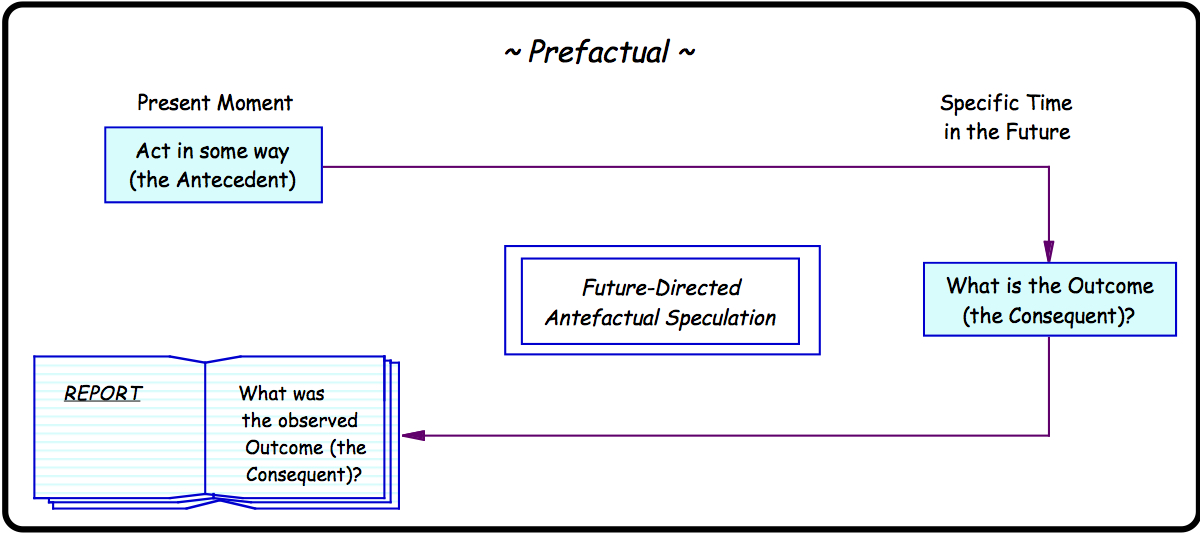
Prefactual (before the fact) thought experiments — — speculate on possible future outcomes, given the present, and ask "What will be the outcome if event E occurs?"


 (2)

Counterfactual (反事實) (過去導向,事前推測)

Counterfactual (contrary to established fact) thought experiments —  — speculate on the possible outcomes of a different past; and ask "What might have happened if A had happened instead of B?" 


(3)

Semifactual (半事實)  (過去導向,事前推測)


Semifactual thought experiments — — speculate on the extent to which things might have remained the same, despite there being a different past; and asks the question Even though X happened instead of E, would Y have still occurred? 


(4)


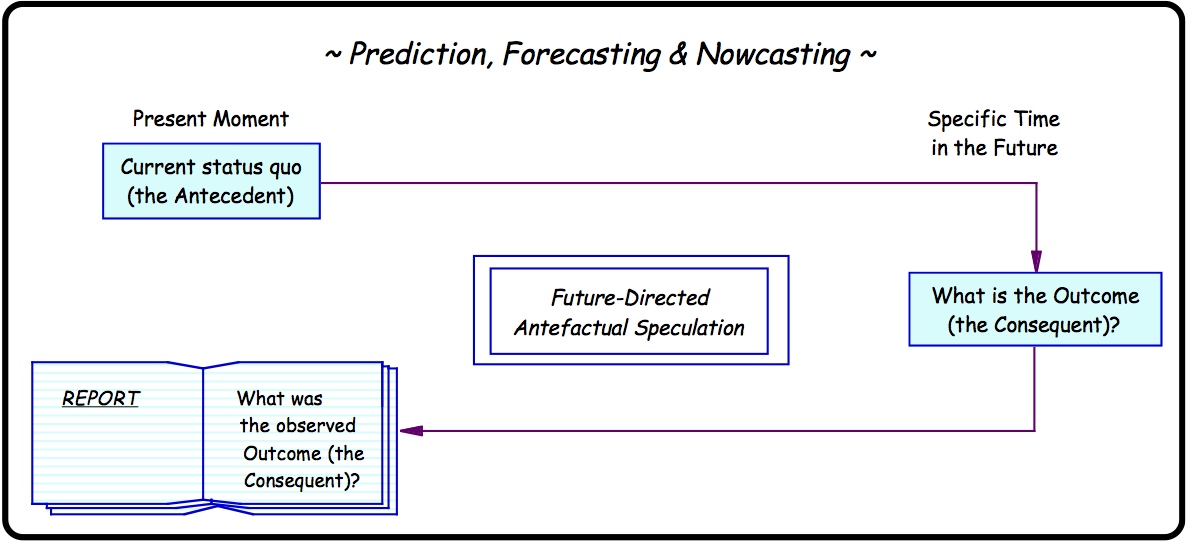
Prediction (預測) (未來導向,事前推測)

The activity of prediction attempts to project the circumstances of the present into the future.


(5)

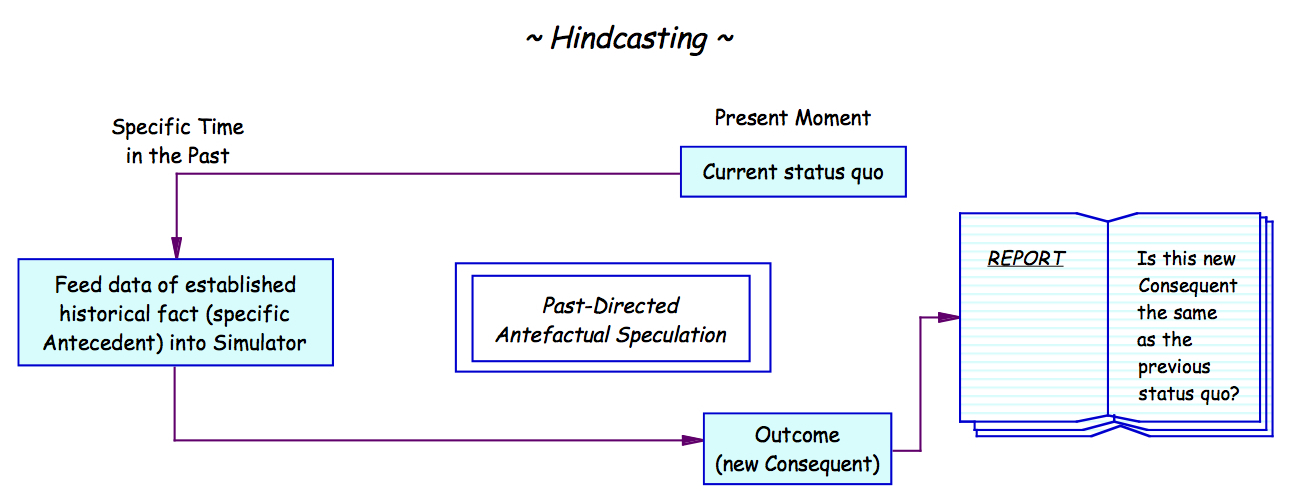
Hindcasting (後報) (過去導向,事前推測)

The activity of hindcasting involves running a forecast model after an event has happened in order to test whether the model's simulation is valid.


(6)

Retrodiction (追溯) (過去導向,事後推測)


The activity of retrodiction (or postdiction) involves moving backwards in time, step-by-step, in as many stages as are considered necessary, from the present into the speculated past to establish the ultimate cause of a specific event (e.g., reverse engineeringand forensics).


(7)


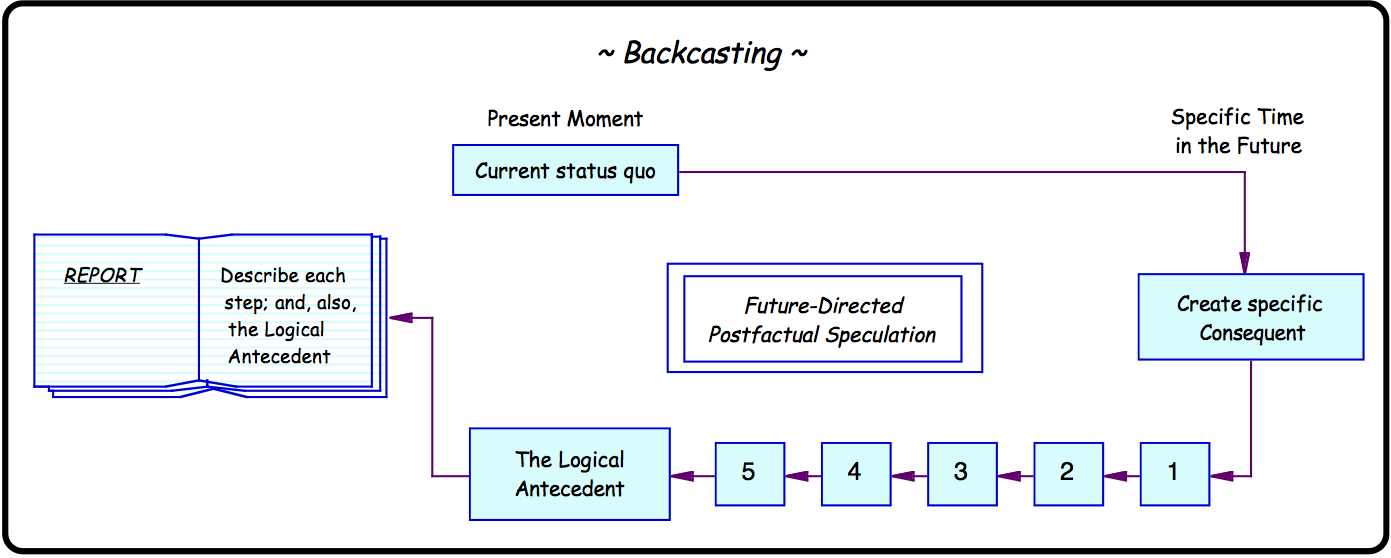
Backcasting (未來回溯) (未來導向,事後推測)


he activity of backcasting —involves establishing the description of a very definite and very specific future situation. It then involves an imaginary moving backwards in time, step-by-step, in as many stages as are considered necessary, from the future to the present to reveal the mechanism through which that particular specified future could be attained from the present.


See Blade runner 2049 ->2048 nowhere to run -> 2036 Nexus Dawn -> Blackout 2022

Bladerunner (1982) 2019


Next week:
  

2023年5月14日 星期日

week 13. parallel universes

1. Students present first-draft proposals for final projects


相較於哲學上對多重實在的形上學探討,物理學更聚焦在「真實世界」的多重性詮釋,即所謂的「平 行宇宙」(parallel universes)。Max Tegmark (2003)發表在美國科學人雜誌上的論文,提出平行宇宙的四 個層次的分類學:

Level 1:
形成我們所在的宇宙的組合方式必定發生過不只一 次,與我們自身相似的對應體(counterparts)必然存在於多重宇宙的某處。在某個與我們宇宙相近的複 本中,我們的對應體正經歷著另一個不一樣的命運。Tegmark 描述第一層次的平行宇宙有相同的物理 定律,但可能在初始值的設定上不同,例如,與我們最接近的複本中的我們的幽靈,已經經歷了 2022 年。


also see:
https://twinstrangers.net/

Level 2:
第二層的另類空間來自於宇宙大爆炸以來,空間的不規則的伸展,所形成的多重世界。根據 Tegmark 的說法,有些區域已經停止伸展並且形成泡泡,而當此泡泡爆炸,便形成新的第一層次多重宇宙。因 此,第二層次的宇宙來自於空間中的遞迴式嵌入(recursive embedding),而 Brian Greene 認為此種現象 是所謂的黑洞效應。...Tegmark 則 認爲 level 2 宇宙與 level 1 有相同的物理定律,但只是在常數和等式中代入不同的數字。

Level 4 第四層次的宇宙基來自於一個思想實驗(thought experiment):此類型宇宙的物理定律沒有絕對的必然 和我們所處的宇宙完全一樣。Tegmark 提問,一個遵循古典物理卻沒有量子效應的宇宙會如何? 時間 是離散(discrete)而非連續的宇宙會如何?Tegmark 建議 level 4 宇宙是所有數學可以描述的所有可能 世界,唯一的限制就是 level 4 宇宙不可違反數學邏輯。

Level 3 這個類型的平行宇宙就是發生在次原子層次最聲名狼藉的奇怪現象,使得物理學家做出平行宇宙的假 設。不同於 level 2 和 level 4(可能與目前的物理定律不同),level 3 對於量子現象之多重世界詮釋,並 未違反任何物理定律。次原子粒子的行為,例如電子,無法以絕對的確定性預測,僅可以機率描述, 但無法預測此機率的哪一部分被真實化(actualized),此機率以數學描述即是所謂粒子的波形函數(wave function of the particle),著名的薛丁格等式(Schrödinger equation)。量子力學的隨機函數,暗示了多重 可能世界:一個電子所有可能的位置和軌跡,只有一個會被實現,其他僅以可能的機率被理解。


哥本哈根詮釋
"哥本哈根詮釋(Copenhagen interpretation)是量子力學的一種詮釋。根據哥本哈根詮釋,在量子力學裏,量子系統的量子態,可以用波函數來描述,這是量子力學的一個關鍵特色,波函數是個數學函數,專門用來計算粒子在某位置或處於某種運動狀態的機率,測量的動作造成了波函數塌縮,原本的量子態機率地塌縮成一個測量所允許的量子態。”  ~wiki


雙縫實驗


量子延遲:


惠勒延遲實驗:


https://www.bilibili.com/video/av25010229/

延遲實驗中量子改變過去:


https://www.bilibili.com/video/av11761018/

量子糾纏


 塌縮 (collapse)
1. 如果應用在人的回憶,是否有相同的現象?
2. 所謂歷史,是否有實在論 (realism),量子觀的歷史如何看待塌縮?
3. 測量是甚麼,意圖在測量中扮演的腳色如何?
4. "意圖"在回顧已發生事件中的腳色如何?
5. 逆向因果律的可能性。

參考: 念力的秘密一書第十一章 "為昨日禱告"

參考文獻:
1. Max Tegmark. 2003. Parallel universes. Scientific American. May, 40-51.

2023年5月6日 星期六

week 12. transmedia narratives & simulacra

http://www.artisopensource.net/2013/10/28/near-future-design-the-perception-of-a-new-possible-and-a-new-role-for-design/


"This is what we have defined as Near Future Design.
A performative dimension in which the observation of the state of the arts and technologies meets anthropological and ethnographical observation."
"
  • The Design Fictions
    • Simulacra
    • Transmedia Narratives "
    • the output of the Design Fiction phase, thus, is constituted by a set of Transmedia Narratives implementing the simulacrum for the story;
    • the Transmedia Narrative is a multi-modal storytelling technique which is able to move and combine the effects of multiple media, from physical objects, to websites, urban interventions and more."

"If, as suggested by Baudrillard, we were to simulate as closely as possible a fake holdup, we just would not be able to do it, because the people and, in general, the “machine”, the process through which people constantly interpret the reality they have around them, would not be able to distinguish the signals of what is real and fake/simulated."

Transmedia Narratives

a transmedia story represents the integration of entertainment experiences across a range of different media platforms
Henry Jenkins, 2007

2023年4月29日 星期六

week 11. introduction to entanglement HCI

1.

Entanglement HCI The Next Wave? (2019 TOCHI)


  mentioned research in our lab:
  (a) 

"Interview with Things": A First-thing Perspective to Understand the Scooter's Everyday Socio-material Network in Taiwan (2017 DIS)

  (b) 

Botanical Printer: An Exploration on Interaction Design with Plantness (2018 DIS)


2.
3. 

Data Epics: Embarking on Literary Journeys of Home Internet of Things Data (2021 CHI)

4.


7.

8. 
by Superflux


9.
by PSK Studio
1. 5/15 each team presents a proposal
2. related artifact, portfolios
3. available generative AI tools, and imaginative future AI tools
4. Narratives with time and possible worlds 

expected final project requirements:
1. A set of design fiction artifacts (props, documents, trans-media narratives)
2. Design fiction that present possible world with audio-related topics (sonic artifacts)


Final Due date: June 5, 2023

2023年4月22日 星期六

week 10. material speculation

1. Students present AI generated Neuromancer-entangled Taipei Scenes
  (1) identify the possible scenes, scenarios, (quotes) in the Neuromancer fiction
  (2) apply qualities of speculative aesthetics to the scene with proper prompts
  (3) generate and choose the scene
  (4) name it and cite the texts in the book

other Neuromancer related objects and scenarios:


William Gibson's Neuromancer: Concept Art

2. Paper reading: Material Speculation (AA'15)
3. Rung-Huei Liang. 2013. Pragmatist Poetics in Interaction Design. (IASDR 2013)


"Bachelard sets material imagination apart from formal imagination [2]. Rather than being conceived intellectually in formal imagination, material imagination is an idea that comes from contact with nature material, such as water and fire." p. 2524


Questions:
  1. What are counterfactual artifacts?
       (containing an 'if'- clause that is contrary to fact)
      nonfunctional prototypes, storytelling props, fictional objects
  2. What is Possible World Theory?
  3. What is pragmatist speculation?
  4. What is formal speculation v.s. material speculation?


Final Project:
Design Fiction with AI 


2023年4月16日 星期日

week 9. design fiction (revisiting Neuromancer)

1. students present images of Neuromancer chap1, 2
2. What is Design Fiction?
    What is Prop?
    What is Diegetic Prototype?


Core77 2022 Speculative Design

The Solution Printer: Magic Realist Design Fiction


Discussion:
1. What are the differences between Design Fiction and Speculative Design?
    (clear fiction v.s. techno-poetic speculation)
2. Aesthetics of speculation: What if an an everyday object is a diegetic prototype of another possible world?


How about science fiction?


also see TEI 2017 student design challenge references:

Watching/Reading List
We encourage wild, obscure references to any kind of sci-fi media. Here’s some our favourite to get you started


      • Vermilion sands [JG Ballard] - Houses with memory, living fashion and sound jewellry.
      • Rainbows End [Vernor Vinge] - Augmented Reality, haptic feedback and silent messages.
      • Snow Crash [Neil Stephenson] - Virtual reality, physical augmentations.
      • Her [Spike Jonze] - computers as people, ubiquitous computing, super AI.
      • Matrix [The Wachowski Brothers] - simulated reality, downloading programs into the brain
      • Blade Runner [Ridley Scott] - Dystopian futures, Androids and AI, replication of beings.
      • Brainstorm [Douglas Trumbull] - physically experiencing somebody else's reality
      • Diamond Age [Neil Stephenson] - parenting from afar via evolving storytelling
      • Dune [Frank Herbert] - cognitive augmentation

https://tei.acm.org/2017/sdc.php


EX:
觀察生活周遭, 拍照片表達對照的概念
   例如:
   未來 vs. 過去, 推測的世界 (what we have the potential to become) vs. 現狀  (what we are) 
   都市場景, 交通工具, 廢墟/大樓, 生活用品, 信仰, 政治, 國際經濟, 權力, 社會制度, 家庭制    度, 教育, 身體, 運動, 休閒, 品牌, 符號, 文字, 自然環境, 物種....


Reference:

Design fictions an introduction and provisional taxonomy

by Derek Hales

Neuromancer
Part I : Chiba City Blues

"The sky above the port was the color of television, tuned to a dead channel."

神經喚術士
第一部: 千葉市藍調

"港口上空是電視的顏色,電視調至死頻的顏色。"


https://www.youtube.com/watch?v=b1kJI-UvYwQ
https://www.youtube.com/watch?v=NNVbrHjX-xs


2023年4月9日 星期日

week 8. soundscape fiction project demo

1.  AI aided soundscape fiction demo

2. Introducing Part II Design Fiction

        Design Fiction

        Transmedia Narratives & Simulacra

        Material Speculation

EX5 (AI-generative Neuromancer Images)

1. generate Neuromancer related images (according to Chap. 1, 2)

2. generate Neuromancer-entangled Taipei scenarios

 神經喚術士第一章:

http://epochtext.com/12NM/nm00.php